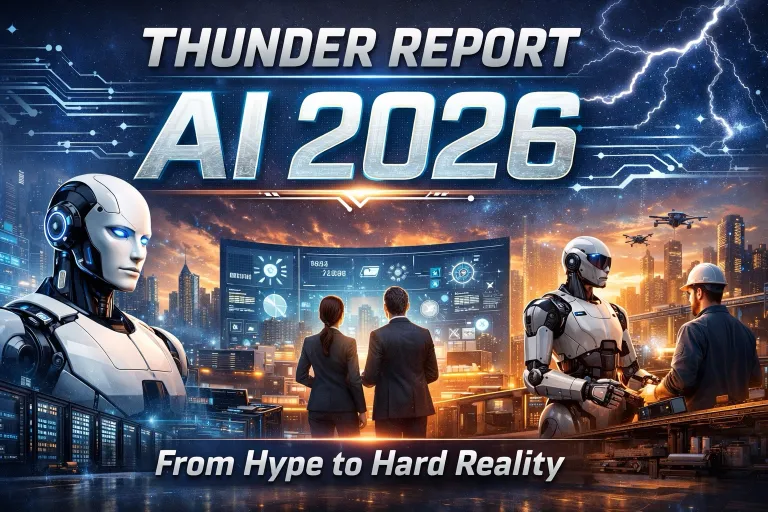
By Michael Phillips | Thunder Report
As 2026 begins, artificial intelligence is entering a more sobering—and more consequential—phase. The breathless hype of the early 2020s is giving way to something far more serious: enterprise-scale deployment, real productivity tradeoffs, and unavoidable political and economic consequences.
Across forecasts from Microsoft, Gartner, Forrester, and Stanford University, a clear picture emerges. AI is no longer a novelty. It is becoming infrastructure—powerful, expensive, and increasingly regulated.
AI Agents Become Digital Coworkers
One of the biggest shifts in 2026 is the rise of AI agents—autonomous systems capable of planning, reasoning, and executing multi-step tasks. Instead of passive chatbots, businesses are deploying “digital teammates” that manage workflows, analyze data, and automate repetitive decision-making.
Gartner predicts that roughly 40% of enterprise applications will embed task-specific AI agents this year, up dramatically from just a year earlier. Forrester goes further, warning that entire data and operations teams may shrink as agents absorb routine workloads. From a center-right perspective, this is less about novelty and more about efficiency: companies are cutting costs, reallocating labor, and demanding measurable returns.
Multimodal AI Grows Smarter—but Not Omniscient
AI systems in 2026 are better listeners, watchers, and speakers. Models now process text, images, video, audio, and actions together, enabling more natural interfaces and stronger performance in coding, logistics, and scientific research.
But the limits are increasingly clear. Better reasoning does not mean perfect reasoning. Hallucinations persist. Long-context models remain expensive. And despite breathless headlines, artificial general intelligence (AGI) is still not here. Markets are rewarding realism over moonshots.
The “Year of the Robot” Arrives
For years, humanoid robotics promised more than it delivered. That changes in 2026. Companies like Tesla and Boston Dynamics are moving from demos to deployments, especially in manufacturing, warehousing, and infrastructure maintenance.
This matters politically. Physical AI directly impacts labor markets, reshaping blue-collar work long before many policymakers are ready. Unlike software, robots don’t hide behind screens—they show up on factory floors.
ROI Replaces Romance in the Enterprise
The era of “AI everywhere” experimentation is ending. Enterprises are consolidating vendors, cutting underperforming pilots, and doubling down on tools that demonstrably reduce costs or increase output.
Budgets are shifting from headcount to infrastructure. Some firms are even conducting “AI-free” skills audits, concerned that overreliance on automation is degrading institutional competence. This is a classic market correction: enthusiasm meets accountability.
Governance, Regulation, and Backlash
AI governance is no longer optional. Analysts expect a majority of large corporations to appoint dedicated AI oversight executives in 2026. Lawsuits tied to algorithmic errors, bias, and automated decision-making are rising, and regulators—especially in Europe—are tightening rules around high-risk systems.
In the U.S., AI is also becoming a political issue. Election security, labor displacement, and surveillance concerns are entering mainstream debate, raising questions about national competitiveness and technological sovereignty.
Data Scarcity and Synthetic Solutions
One of AI’s quiet crises is data. As more of the internet becomes AI-generated, training on “real” human content grows harder. The response is synthetic data—simulated environments, world models, and digital replicas of physical processes.
This approach may keep progress moving, but it also raises reliability and accountability questions that regulators and investors are only beginning to confront.
The Workforce Reality Check
Despite dire predictions, most jobs will not disappear in 2026. Instead, AI will re-sort the labor market, rewarding those who can supervise, integrate, and strategically deploy AI systems. A widening gap between “AI superusers” and everyone else is already visible.
At the same time, economists warn that post-recession recoveries may increasingly be “jobless,” as AI agents absorb marginal workloads that once justified new hires.
Bottom Line
AI in 2026 is no longer about dreams of digital gods or utopian automation. It is about power, productivity, and tradeoffs. The technology is becoming more useful—and more dangerous—at the same time.
For conservatives and pragmatists alike, the lesson is simple: AI is not destiny, but it is leverage. Nations, companies, and workers who approach it with discipline, skepticism, and strategic intent will benefit. Those who chase hype—or ignore the risks—will not.
The age of experimental AI is ending. The age of accountable AI has begun.




 TechBay.News
Leave a comment