By Michael Phillips | TechBay.News / Thunder Report
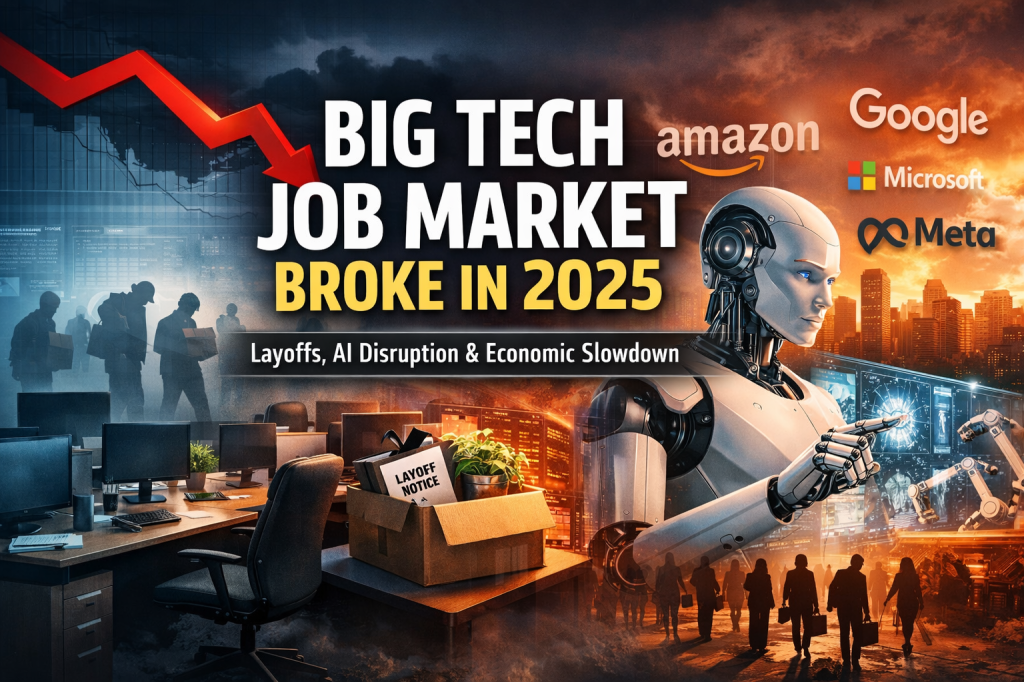
By the end of 2025, one reality had become unavoidable: the Big Tech job market was no longer merely cooling—it had fundamentally cracked.
A December 2025 analysis by Business Insider captured what many workers had already experienced firsthand. After years of aggressive pandemic-era hiring, tech giants slammed the brakes, unleashing sustained layoffs and historically weak hiring that left even highly credentialed professionals struggling to land interviews. As 2026 begins, the lesson is clear: the era of effortless tech employment is over.
Layoffs Became a Feature, Not a Bug
The numbers tell a sobering story. According to Challenger, Gray & Christmas, U.S. tech companies announced roughly 154,000 layoffs through November 2025—more than any other private-sector industry and a 17% increase over the prior year. Independent trackers such as Layoffs.fyi and Crunchbase place total global tech cuts for the year between 120,000 and 130,000.
The biggest names led the charge. Amazon and Microsoft accounted for tens of thousands of reductions, including Amazon’s 14,000 corporate cuts in October alone. Meta, Google, Intel, and Tesla followed suit, trimming staff while redirecting capital toward AI infrastructure.
This was not a cyclical downturn—it was a structural reset. Companies that once hoarded talent began optimizing for leaner, automation-heavy operations.
A Brutal Hiring Environment for Workers
For displaced tech workers, layoffs were only the first blow. Hiring slowed to a crawl. Indeed data shows tech job postings fell roughly 33% below early 2020 levels by late 2025. Remaining openings attracted massive applicant pools—an average of 242 applications per role last quarter, nearly triple 2017 levels.
Ironically, AI made the process worse. Automated application tools flooded recruiters with resumes, forcing employers to filter more aggressively and hunt for “perfect” candidates who could deliver immediate value. For job seekers without niche or AI-specific skills, résumés often disappeared into algorithmic black holes.
Personal accounts in Business Insider highlighted the human cost: former Microsoft engineers unemployed for a year, Amazon veterans burning through savings, and families relocating to survive. Even strong performers learned that brand-name experience was no longer a safety net.
AI: Disruptor First, Creator Later
Artificial intelligence sat at the center of the 2025 shakeout. Companies openly cited AI-driven efficiency as a reason for cutting roles—particularly in support, administration, data entry, and even traditional programming. Challenger data shows more than 55,000 U.S. layoffs explicitly linked to AI in 2025, with broader white-collar job cuts exceeding 1.1 million across all sectors.
Entry-level and mid-level white-collar roles were hit hardest. Programmer employment in the U.S. fell sharply from 2023 to 2025, while employers hesitated to hire amid uncertainty over how fast AI could replace routine work.
Yet this is only half the story. Longer-term projections remain more optimistic. The World Economic Forum estimates AI could displace 92 million jobs globally by 2030—but create 170 million new ones, a net gain of 78 million. Demand is already surging for AI-literate talent, with roles in machine learning, data engineering, cloud infrastructure, and AI governance commanding significant pay premiums.
The Conservative Lesson: Efficiency Has Consequences
From a center-right perspective, the 2025 tech collapse reflects market discipline catching up with excess. Pandemic overhiring, cheap capital, and speculative growth narratives inflated payrolls beyond sustainable demand. The correction, while painful, was inevitable.
But efficiency has consequences. Rapid automation without parallel investment in retraining risks hollowing out the middle class of white-collar workers who powered the last tech boom. Markets can reallocate capital efficiently—but workers cannot re-skill overnight.
The companies that thrive in 2026 and beyond will not be those that simply cut fastest, but those that pair AI adoption with serious workforce development. Likewise, workers who adapt—by acquiring AI fluency and strengthening uniquely human skills like judgment, creativity, and leadership—will find opportunity even in a leaner market.
Looking Ahead to 2026
As the new year begins, Big Tech hiring has stabilized at low levels, but the pressure remains. Investors expect continued layoffs as AI budgets expand, even in a stable economy. Entry-level tech jobs may remain scarce, while competition for AI-adjacent roles intensifies.
The verdict of 2025 is unmistakable: the old tech employment model is gone. In its place is a more disciplined, automation-driven industry that rewards adaptability and punishes complacency. For workers and employers alike, the next phase will demand realism—not hype—and a willingness to evolve.




 TechBay.News
Leave a comment