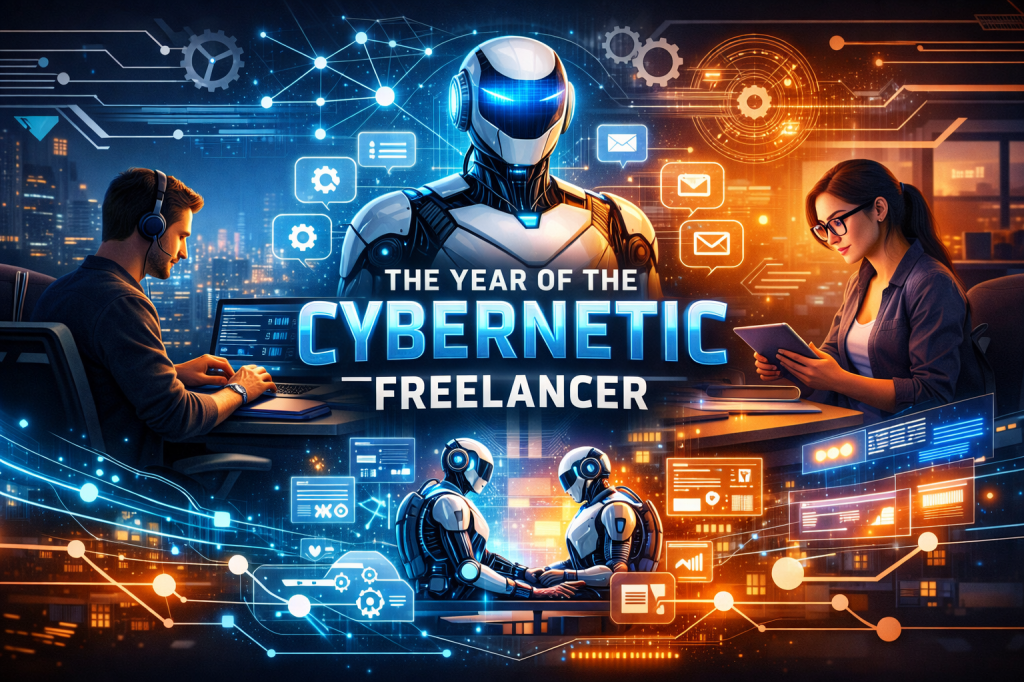
Why 2026 Is the Year of the Cybernetic Freelancer
By Michael Phillips | TechBay.News
As of early 2026, generative AI has not eliminated freelance work—it has fundamentally reshaped it. The result is a sharply polarized marketplace: routine, low-value gigs are collapsing under automation, while AI-enabled, high-skill freelancers are seeing explosive growth, higher rates, and more durable client relationships.
This is not a story of mass extinction. It’s a story of adaptation—and of markets doing what markets do best: rewarding leverage, specialization, and productivity.
The Disruption Was Real—and Painful
There’s no sugarcoating what happened between 2023 and 2025. After the launch of ChatGPT and image-generation tools, demand for traditional freelance tasks dropped sharply:
- Writing, coding, and design gigs declined roughly 20–25%, with earnings falling 5–17% in affected categories.
- Graphic design and image creation saw double-digit job declines after tools like DALL·E and Midjourney went mainstream.
- Entry-level and mid-tier work—boilerplate code, SEO filler content, simple graphics—was hit hardest.
Even top-performing freelancers weren’t immune. Higher past earnings often correlated with steeper opportunity declines, as AI neutralized advantages like speed and cost. The market bifurcated into a barbell economy: automated low-end work on one side, elite, specialized services on the other.
Freelance platforms felt it too. Engagement and downloads dipped at Upwork and Fiverr in 2024–2025 as clients experimented with AI for basic tasks.
But that downturn was not the end of freelancing—it was the reset.
The AI Rebound: Where Growth Is Exploding
By late 2025, the trend reversed for those who adapted. Demand for AI-capable freelancers surged:
- AI-related freelance roles grew 60–70% year over year on major platforms.
- AI-proficient freelancers now earn 28–56% premiums over non-adopters.
- Roles like chatbot development, automation design, and machine learning integration nearly tripled in demand.
Platforms adjusted quickly. Upwork now prioritizes AI proficiency in the majority of hires, while Fiverr has leaned into “Personal AI” tools that let freelancers scale their own style rather than compete with generic models.
The message from the market is clear: AI is not replacing freelancers—it’s replacing undifferentiated freelancers.
Agentic AI: The 2026 Inflection Point
The most important shift heading into 2026 is the rise of agentic AI.
Unlike traditional generative tools that respond to prompts, agentic systems can plan, reason, and execute multi-step tasks autonomously—interacting with tools, APIs, and workflows along the way. Think less “chatbot,” more digital colleague.
Frameworks such as LangChain, AutoGPT, CrewAI, and n8n have pushed agentic AI from hype to deployment. Many analysts now call 2026 the year of multi-agent systems in production.
For freelancers, this has unlocked an entirely new class of work.
High-Value Freelance Roles Built on Agentic AI
Businesses struggle to implement agentic systems internally, so they outsource. The result is one of the fastest-growing freelance niches on record:
- Searches for “AI agents” on Fiverr surged over 18,000% in six months.
- Between 30–50% of advanced AI freelance projects now involve agent orchestration.
Common services include:
- Custom AI agents for workflow automation
- Voice-enabled customer support agents
- Multi-agent research and execution systems
- Integration with tools like Zapier, Monday.com, and custom APIs
Rates reflect the value delivered. Skilled freelancers charge $75–$250 per hour or $5,000–$25,000 per project, often tied to measurable outcomes like saving clients 20+ hours per week.
Freelancers Using AI as a Teammate, Not a Threat
Just as important: freelancers are using agentic AI internally to scale themselves.
Solo operators now deploy agents to:
- Automate outreach, invoicing, and scheduling
- Scan job boards and customize proposals
- Handle research, drafts, and analytics
The result is the rise of the one-person firm—freelancers operating with the leverage once reserved for agencies. Productivity gains of 30–50% are common, allowing higher output without burnout and freeing humans to focus on strategy, judgment, and relationships.
AI handles the drudgery. Humans deliver the value.
The 2026 Outlook: A Market That Rewards Competence
Looking ahead, the freelance economy is stabilizing on new terms:
- Routine work continues to decline—and won’t come back.
- AI-first freelancers gain visibility, pricing power, and repeat clients.
- Subscription and retainer models rise as AI-enabled services become ongoing infrastructure, not one-off gigs.
Yes, displacement remains real for non-adapters. But for those who upskill, the outlook is net positive. Global freelancing already represents a $500B+ market, and AI is expanding—not shrinking—the top end.
The future belongs to specialists who can design, supervise, and integrate AI systems, while bringing human judgment, ethics, and accountability to the table.
Bottom Line
AI did not destroy freelancing. It stripped away the illusion that low-cost, low-skill work was sustainable in a global digital economy.
In its place is a harder—but far more rewarding—market that favors ownership, leverage, and expertise. Freelancers who embrace AI as a cybernetic teammate are building $10,000+ per month businesses without constant bidding or burnout.
The message of 2026 is simple:
Adapt, specialize, and scale—or be automated out of the middle.
For independent workers willing to evolve, the opportunity has never been bigger.




 TechBay.News
Leave a comment