By Tech Bay News Staff
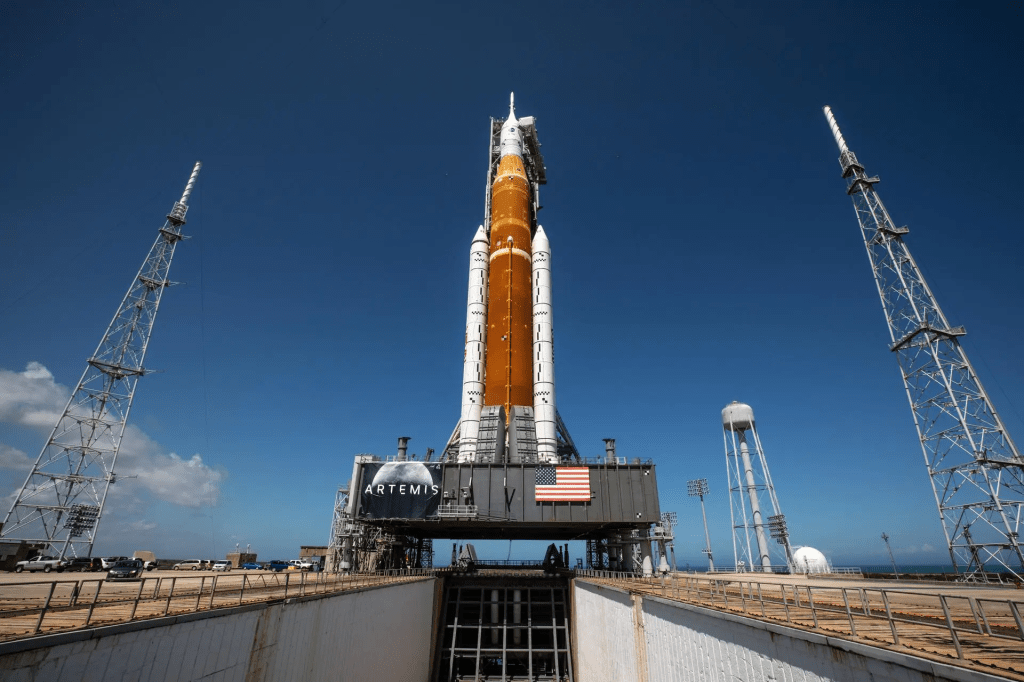
On January 17, 2026, NASA completed a highly symbolic and technically demanding milestone: rolling the Artemis 2 Space Launch System (SLS) rocket to Launch Pad 39B at Kennedy Space Center. The slow, deliberate journey marked a decisive step toward the United States’ first crewed mission beyond low Earth orbit in more than half a century—and a critical test of whether America can still execute big, complex space programs at scale.
The rollout, covered live by Space.com, saw the 322-foot-tall SLS rocket—topped with the Orion crew capsule—travel roughly four miles from the Vehicle Assembly Building atop the historic Crawler-Transporter 2. Moving at barely one mile per hour and carrying an 11-million-pound stack, the trip took more than 11 hours, concluding shortly before 7 p.m. Eastern.
A Crewed Mission With Strategic Weight
Artemis 2 is not just another launch on NASA’s calendar. It will carry four astronauts—Reid Wiseman, Victor Glover, Christina Koch, and Jeremy Hansen—on a roughly 10-day mission that will loop around the Moon without landing. The flight is designed to validate life-support systems, navigation, and deep-space operations ahead of future lunar landings later in the decade.
From a policy perspective, Artemis 2 is also a signal mission. The United States is racing to reassert leadership in human spaceflight as China accelerates its own lunar ambitions. A successful crewed flyby would reinforce U.S. credibility—not just technologically, but geopolitically.
Old Hardware, New Demands
The rollout itself underscored the hybrid nature of NASA’s current approach: cutting-edge spacecraft riding atop infrastructure that dates back to the Apollo era. The crawlerway, the transporters, and even Pad 39B are legacy assets—modernized, but still demanding precision and patience.
That caution reflects lessons learned from Artemis 1, the uncrewed test flight in 2022, which exposed issues such as hydrogen leaks during fueling. Those problems did not threaten the mission’s ultimate success, but they forced NASA to adopt a slower, more methodical posture for Artemis 2.
What Comes Next
With the rocket now secured at the pad, engineers will prepare for a “wet dress rehearsal,” currently scheduled for early February. This full fueling test—using super-cold liquid hydrogen and oxygen—will simulate launch countdown conditions and verify fixes implemented since Artemis 1.
NASA has identified an opening launch window beginning around February 6, though officials have been explicit that safety, not schedule, will drive the final decision. If additional testing or repairs are needed, the agency can roll the rocket back to the VAB and target later windows in March or April.
A Moment of Accountability for NASA
For supporters of a strong national space program, Artemis 2 represents both promise and pressure. The SLS program has faced years of delays and ballooning costs, drawing criticism from fiscal conservatives and commercial-space advocates alike. A smooth Artemis 2 mission would go a long way toward justifying those investments—and restoring confidence that government-led exploration still has a role alongside private launch providers.
As the towering rocket now stands at Pad 39B, the visuals echo Apollo—but the stakes are modern. Artemis 2 is not just about going back to the Moon. It’s about proving that the United States can still deliver complex, crewed exploration missions in an era of global competition, tight budgets, and rising expectations.


 TechBay.News
Leave a comment