By Tech Bay News Staff
The U.S. military is making a clear, pragmatic bet on robotics over risk.
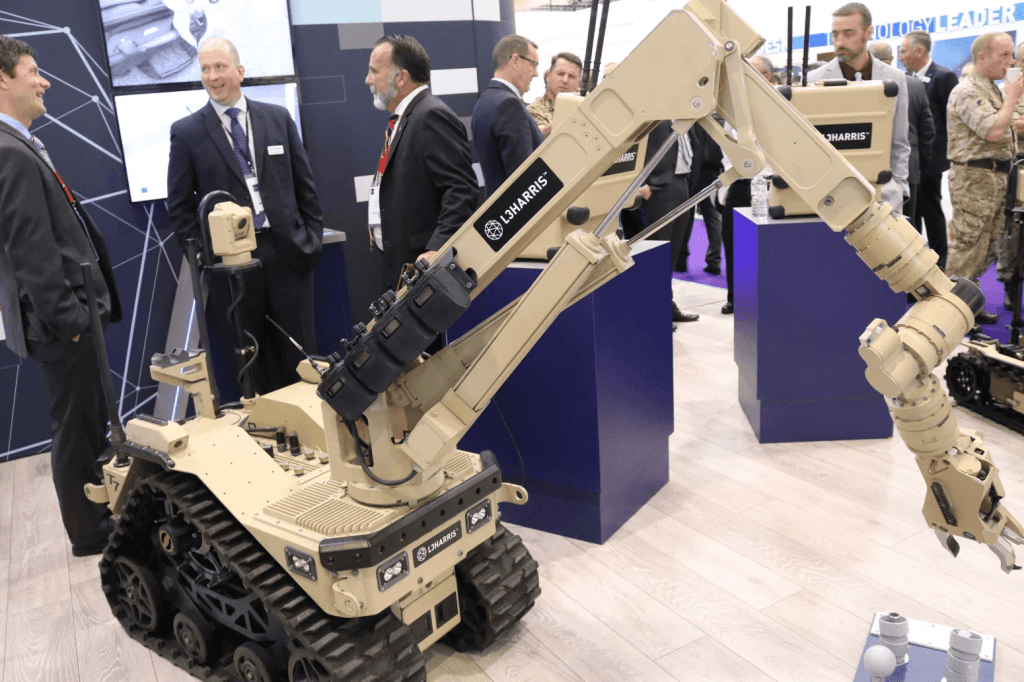
Under a newly announced Department of Defense contract, L3Harris Technologies will deliver 34 of its large-class T7 Multi-Mission Robotic Systems to the U.S. Navy and U.S. Marine Corps, expanding the services’ explosive ordnance disposal (EOD) capabilities beginning in 2026.
The deal, first reported by Military Times, reflects a broader shift across the Pentagon: reduce unnecessary risk to personnel by replacing “hands-on” danger with reliable, battle-tested machines.
A Robot Built for the Worst Jobs
The T7 is not a novelty gadget or a science-fair demo. It is a rugged, tracked unmanned ground vehicle designed specifically for the most dangerous scenarios EOD teams face—vehicle-borne IEDs, unexploded ordnance, and hazardous materials.
Key capabilities include:
- A heavy-duty robotic arm capable of lifting nearly 300 pounds near its base
- Interchangeable tools for bomb disruption and manipulation
- Multiple camera feeds for tight or obscured environments
- Stair-climbing tracks for urban and shipboard operations
- Long battery life and high speed compared to older EOD platforms
Most importantly, the T7 allows operators to stay at a safe standoff distance while still performing precise, delicate work that once required a human in a bomb suit.
Why Haptics Matter More Than Cameras
What sets the T7 apart—and explains why EOD technicians consistently praise it—is its haptic feedback controller.
Unlike older robots that rely almost entirely on video feeds, the T7’s controller transmits physical sensations back to the operator’s hand. Sensors in the robot’s gripper detect pressure and resistance, translating them into subtle vibrations or force feedback.
That means an operator can feel when the robot touches a wire, applies too much pressure, or encounters resistance while cutting or turning a component. In bomb disposal, that tactile awareness can be the difference between a controlled neutralization and a catastrophic mistake.
In practical terms, haptics reduce errors, shorten mission time, and lower the cognitive strain on technicians—while keeping them well outside the blast radius.
Proven System, Expanded Mission
The Navy and Marine Corps are not early adopters taking a gamble. The U.S. Air Force began fielding the T7 in 2021, ordering 170 units for its own EOD teams. Airmen who trained on the system cited its speed, endurance, and flexibility as major improvements over legacy robots.
Allied militaries—including the United Kingdom and Australia—have also deployed T7 and its smaller sibling, the T4, for similar missions.
L3Harris will provide comprehensive training to Navy and Marine personnel, and the shared controller design across the T7 and T4 platforms reduces training time and long-term sustainment costs—an increasingly important consideration as defense budgets face pressure.
Technology Serving a Conservative Goal: Fewer Casualties
There is nothing ideological about bomb disposal. The mission is simple: neutralize threats and bring everyone home alive.
From a center-right perspective, the appeal of systems like the T7 is straightforward:
- They reduce long-term medical costs from blast exposure
- They preserve experienced personnel instead of burning them out
- They deliver measurable results without speculative “moonshot” spending
This is technology serving a conservative goal: efficiency, readiness, and the protection of human life without expanding bureaucracy or manpower.
As unmanned systems quietly take on more of the military’s most dangerous tasks, the T7 program underscores a reality that cuts across politics—smart automation, when deployed responsibly, saves lives.
For the Navy and Marine Corps, that alone makes this investment an easy call.


 TechBay.News
Leave a comment