By Tech Bay News
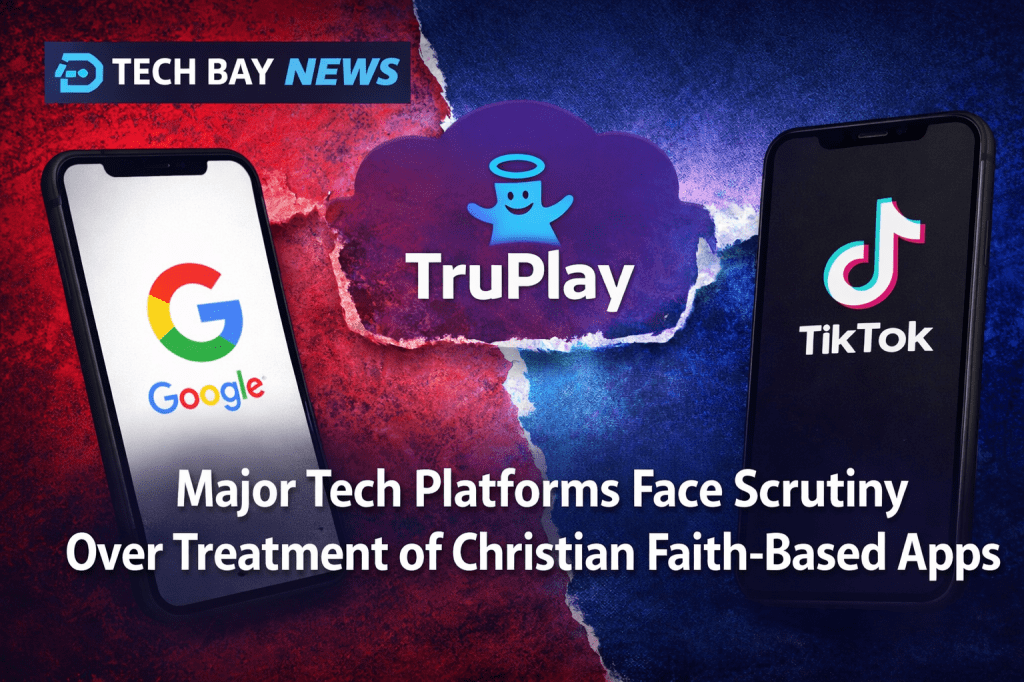
A growing dispute involving TruPlay, a Christian-owned family entertainment app, is reigniting a long-simmering debate in tech policy circles: whether major platforms can credibly claim neutrality while exercising sweeping control over which values, viewpoints, and business models are allowed to thrive online.
According to reporting and commentary circulating this week, TruPlay alleges it has been sidelined by Google and TikTok through reduced visibility, advertising restrictions, or policy-based friction—despite the platforms continuing to host and monetize far more explicit or violent content.
The companies involved have not publicly acknowledged targeting TruPlay for its religious orientation, instead pointing to content moderation and advertising policies applied across the board. But critics argue that the practical effect tells a different story.
From “Neutral Platforms” to Cultural Gatekeepers
For years, large tech firms have insisted they are neutral intermediaries—enforcers of rules, not arbiters of culture. Yet cases like TruPlay’s raise uncomfortable questions about how those rules are written, interpreted, and enforced.
Faith-based platforms often operate under stricter content standards than mainstream entertainment apps, particularly around sexuality, violence, and language. Ironically, those standards can clash with platform policies optimized for engagement-driven ecosystems where controversy, shock, and virality are rewarded.
Critics on the center-right see this as part of a broader pattern: content aligned with traditional or religious values facing higher scrutiny, while material that pushes cultural boundaries enjoys algorithmic amplification and advertising access.
The Business Impact Is Real
Beyond ideology, there are tangible economic consequences. App store visibility, search rankings, and ad monetization are existential issues for startups and niche platforms. When a company like TruPlay encounters friction at the distribution level, it isn’t just a speech issue—it’s a market access issue.
In effect, a handful of tech firms now function as quasi-regulators of the digital economy. Their internal policy decisions can determine which apps grow, which stagnate, and which quietly disappear.
That concentration of power is increasingly drawing attention not only from cultural conservatives, but also from antitrust advocates, parents’ groups, and developers who worry about opaque enforcement and inconsistent standards.
A Larger Policy Reckoning Ahead
The TruPlay controversy arrives at a moment when lawmakers across the political spectrum are reevaluating the role of major platforms. Questions about viewpoint discrimination, algorithmic bias, and the lack of due process for developers are no longer fringe concerns.
For center-right critics, the issue isn’t whether private companies can set rules—they can—but whether those rules are being used to quietly shape the digital public square while still claiming neutrality.
If platforms are going to act as cultural gatekeepers, critics argue, they should at least be transparent about the values they’re enforcing.
Why This Matters for Tech Policy
Whether or not TruPlay ultimately prevails, the episode highlights a structural problem in the modern internet: distribution power is concentrated in too few hands, and appeals processes are often unclear or inaccessible.
For Tech Bay News readers tracking the intersection of technology, policy, and culture, this case is less about one app and more about a system that increasingly blurs the line between platform management and ideological enforcement.
As debates over content moderation evolve, cases like TruPlay’s may shape the next phase of regulatory and cultural scrutiny—especially as families, developers, and policymakers ask who really decides what belongs online.




 TechBay.News
Leave a comment