By TechBay.News Staff
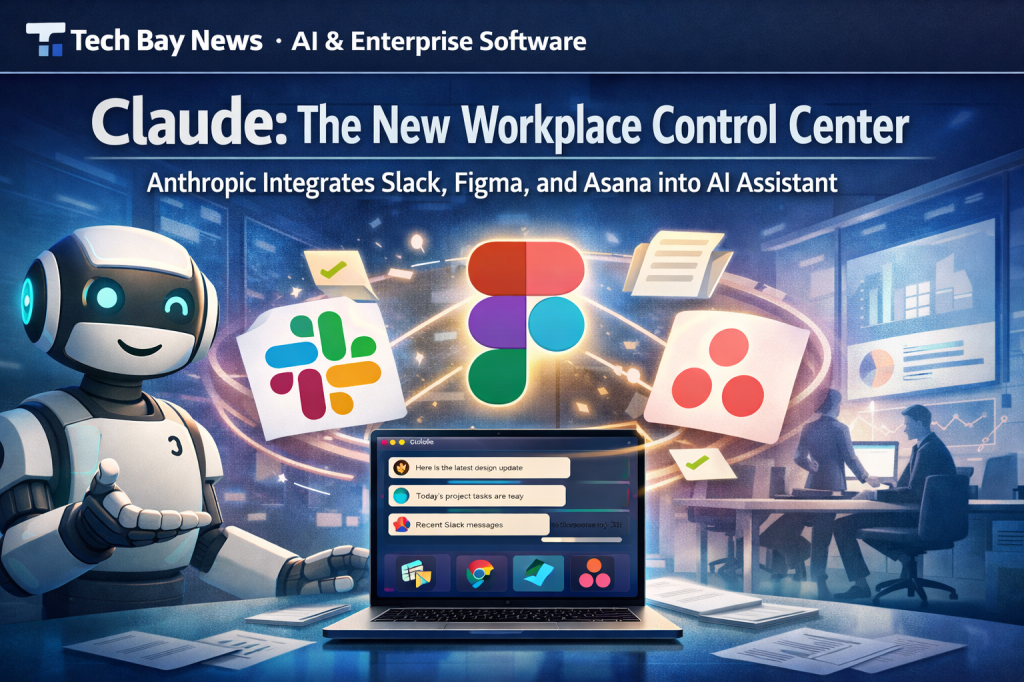
Anthropic is making a decisive push into enterprise productivity. This week, the AI company announced that Anthropic has embedded major workplace platforms—Slack, Figma, and Asana—directly inside Claude, transforming its chatbot into a unified work interface rather than a standalone AI assistant.
The move signals a broader shift in how AI companies are positioning their products: less as novelty tools and more as operational infrastructure for modern organizations.
From Chatbot to Command Center
Instead of forcing users to jump between apps, Anthropic’s new integrations allow Claude to see and act across core workplace tools:
- Pull conversations, decisions, and context from Slack
- Review, summarize, and reason about Figma designs
- Track tasks, timelines, and blockers inside Asana
In practice, this means Claude can answer questions like “What design feedback is still unresolved?” or “Which tasks are blocking this sprint?” without users manually stitching information together.
This is not just convenience—it’s an attempt to reduce the coordination tax that plagues large organizations.
A Strategic Bet on Enterprise Trust
Anthropic’s approach contrasts with consumer-first AI rollouts that emphasize speed and spectacle. By embedding deeply into enterprise tools, the company is betting that:
- AI adoption will be driven by workflows, not prompts
- Trust, auditability, and permissions matter more than flash
- Enterprises want AI that works with existing systems, not around them
This aligns with Anthropic’s long-standing emphasis on safety, access controls, and predictable behavior—traits that resonate with regulated industries and large employers wary of AI sprawl.
Why This Matters for the AI Market
The integration push also sharpens competition across the AI landscape. Rather than competing purely on model performance, vendors are now fighting to become the default interface for work itself.
If Claude becomes the layer employees use to interact with Slack, design files, and project plans, Anthropic gains leverage that goes far beyond chat quality. It becomes embedded—harder to replace, and more central to daily operations.
This raises real questions for CIOs and IT leaders:
- Who controls the AI layer sitting on top of company data?
- How are permissions enforced across tools?
- What happens when AI becomes the primary “user” of enterprise software?
A Cautious but Powerful Evolution
From a center-right technology policy perspective, this development highlights both promise and prudence. On one hand, AI-driven productivity gains are real and badly needed in an economy struggling with efficiency and labor constraints. On the other, deeper AI integration increases the stakes for data governance, security, and vendor lock-in.
Anthropic’s move suggests the next phase of AI won’t be loud or flashy—it will be quiet, embedded, and operational. The companies that win may not be the ones with the most viral demos, but the ones trusted to sit at the center of real work.
Tech Bay News Takeaway:
Claude’s new integrations mark a shift from AI as a tool to AI as infrastructure. For enterprises, the question is no longer if AI will be embedded into daily workflows—but who will control that layer, and under what rules.


 TechBay.News
Leave a comment