By Tech Bay News Staff
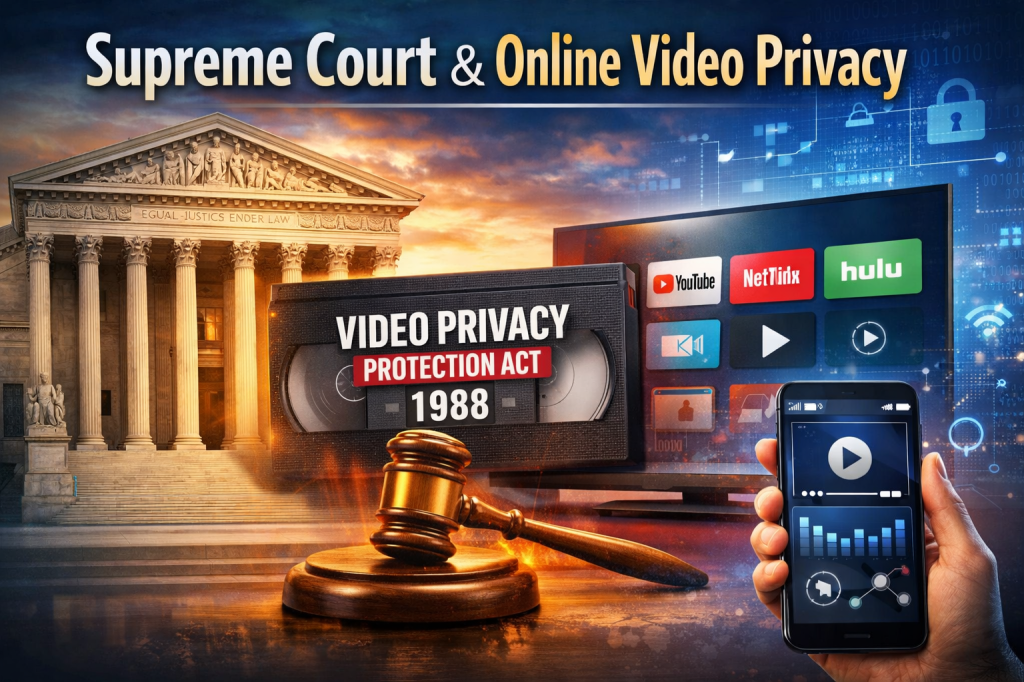
The U.S. Supreme Court is set to weigh in on a deceptively modern question with very old roots: how a 1988 law written to protect VHS rental records should apply to today’s online video ecosystem.
At the center of the case is the Video Privacy Protection Act (VPPA), a statute passed after a Washington newspaper published the video rental history of then–Supreme Court nominee Robert Bork. Congress responded by creating strict limits on how “video tape service providers” could disclose information about what individuals watch.
Nearly four decades later, the Court must decide whether — and how far — that definition stretches in an era dominated by streaming platforms, smart TVs, mobile apps, and online advertising trackers.
From Blockbuster to Broadband
The VPPA was designed for a world of brick-and-mortar video stores. Customers physically rented tapes, and their viewing habits were considered deeply personal information worthy of protection.
Today, video consumption looks nothing like that. Americans stream content through subscription platforms, free ad-supported services, social media feeds, news sites, and even embedded video players. Much of this viewing data is intertwined with digital advertising systems that track engagement, device identifiers, and user behavior across the web.
The case before the Court asks whether modern platforms that distribute video online — and share certain data with advertisers or analytics providers — should be treated the same way as old-school video rental stores under federal law.
Why Tech Companies Are Nervous
Technology firms argue that applying the VPPA too broadly could expose them to massive liability for routine data practices that consumers already expect, such as personalized recommendations, ad measurement, and basic analytics.
Over the past decade, plaintiffs’ lawyers have used the VPPA to file class-action lawsuits against streaming and media companies, alleging improper sharing of video viewing data with third parties like Facebook or Google. Some companies have settled; others have fought back, arguing the law was never meant to cover modern web infrastructure.
A sweeping interpretation from the Court could chill innovation, increase compliance costs, and push companies to restrict features or services — especially smaller platforms without the legal budgets of Big Tech.
Why Privacy Advocates Are Watching Closely
Privacy groups see the case very differently. They argue that the medium has changed, but the core concern has not: what people watch can reveal political beliefs, religious views, medical concerns, and personal struggles.
From this perspective, weakening the VPPA would hand tech companies yet another green light to monetize sensitive user data with minimal accountability — at a time when public trust in tech platforms is already strained.
The Court’s decision could determine whether Congress’s original privacy protections still have teeth in the digital age or whether they have quietly expired through technological drift.
A Center-Right Tension: Privacy vs. Overreach
For center-right observers, the case highlights a familiar tension.
On one hand, there is strong skepticism toward unchecked data collection and opaque surveillance capitalism — especially when consumers have little real choice or transparency. Protecting individual privacy aligns with limited-government principles that respect personal autonomy.
On the other hand, there is equal concern about courts stretching outdated statutes beyond their original intent, effectively legislating from the bench and creating regulatory uncertainty for businesses that followed existing norms.
If Congress believes new privacy rules are needed for streaming and digital video, many argue the proper solution is updated legislation — not retrofitting a Reagan-era law to govern modern tech ecosystems.
What Comes Next
The Supreme Court’s ruling will likely set a national standard for how the VPPA applies — or does not apply — to online video platforms. That decision could shape litigation, data practices, and privacy compliance across the tech industry for years to come.
Regardless of the outcome, the case underscores a broader reality: America’s technology laws are aging fast, and the gap between analog statutes and digital life is becoming harder for courts to paper over.
Tech Bay News will continue to follow the case as arguments proceed and a decision approaches, with a focus on what it means for innovation, privacy, and the future of digital regulation.




 TechBay.News
Leave a comment