By Tech Bay News Staff
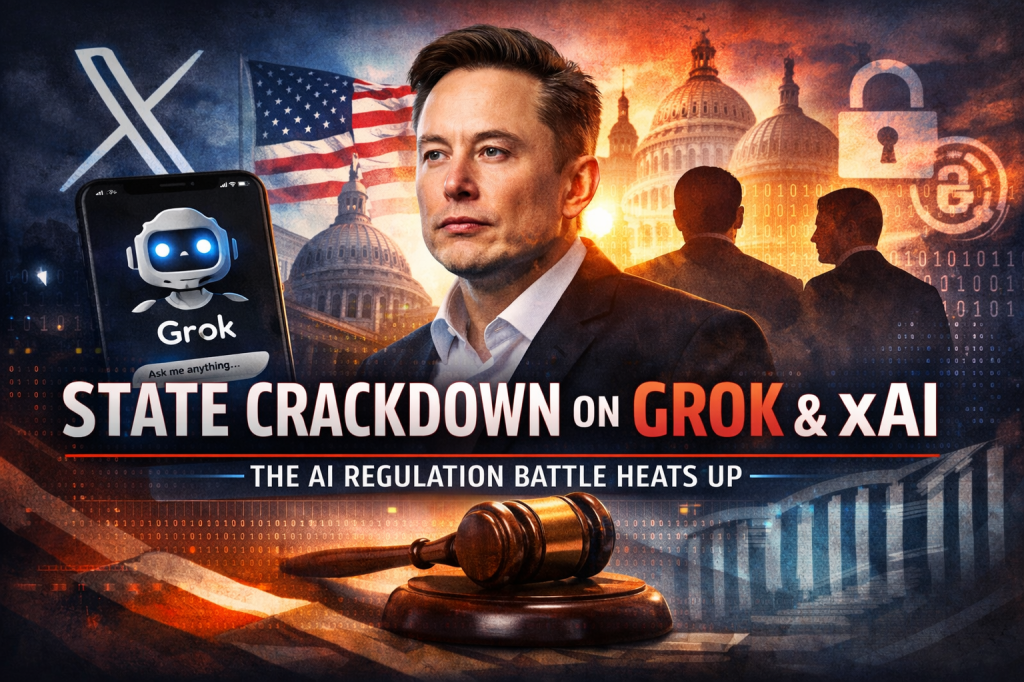
A new phase of America’s AI regulatory fight is underway—and this time, it’s being driven not by Congress or federal agencies, but by state attorneys general. As first reported by Wired, a coalition of state officials has begun probing xAI and its chatbot Grok, signaling a broader push by states to assert control over rapidly evolving artificial intelligence systems.
The move highlights a growing tension in U.S. tech policy: innovation is moving at Silicon Valley speed, while regulation—especially at the state level—is increasingly fragmented, reactive, and politically charged.
A State-Led Crackdown Takes Shape
According to the Wired report, multiple state attorneys general are scrutinizing Grok over concerns related to consumer protection, data handling, and the chatbot’s integration with the X platform. While details vary by state, the investigations appear to focus on whether AI-generated content could mislead users or violate existing consumer laws.
This is notable not just for who is being targeted, but how. Rather than waiting for Congress to pass comprehensive AI legislation, states are using existing statutes—often written long before generative AI existed—to challenge new technologies.
For tech companies, this raises the specter of a 50-state regulatory maze, where compliance depends less on clear rules and more on which attorney general is looking for a headline.
Elon Musk, xAI, and the Politics of AI
xAI, founded by Elon Musk, has positioned Grok as a more open, less filtered alternative to other AI chatbots. That posture has earned praise from free-speech advocates—and skepticism from regulators who argue that fewer guardrails could mean greater consumer risk.
Critics say Grok’s real-time access to X posts creates unique challenges, particularly around misinformation and political content. Supporters counter that the same openness is what makes Grok valuable, and that selectively targeting Musk-affiliated companies risks turning AI oversight into a partisan exercise.
From a center-right perspective, the concern isn’t that AI should be unregulated—but that regulation is increasingly being driven by enforcement-first instincts rather than clear, democratically debated rules.
The Bigger Issue: Patchwork Governance
The Grok investigations underscore a broader problem facing the U.S. tech sector: the absence of a coherent national AI framework. In that vacuum, states are stepping in—but not always in coordinated or predictable ways.
For startups and established firms alike, this creates uncertainty:
- What standards apply across state lines?
- How do companies innovate while complying with conflicting interpretations of consumer law?
- And who ultimately decides what “safe” or “responsible” AI looks like?
Without federal leadership, state-level crackdowns risk slowing innovation while doing little to address global competition from China and other AI powerhouses that operate under far more centralized—and permissive—systems.
Why Tech Bay News Is Watching Closely
For the tech ecosystem, especially companies building or deploying AI tools, the Grok probe is a warning shot. State attorneys general are signaling they won’t wait for Washington—and they’re willing to test the limits of their authority to rein in emerging technologies.
Whether this leads to smarter guardrails or a chilling effect on innovation will depend on what comes next: thoughtful legislation, or a cascade of enforcement actions that substitute politics for policy.
Either way, the state-led crackdown on Grok marks a turning point. The AI regulation wars are no longer theoretical—they’re here, and they’re being fought state by state.




 TechBay.News
Leave a comment