By TechBay.News Staff
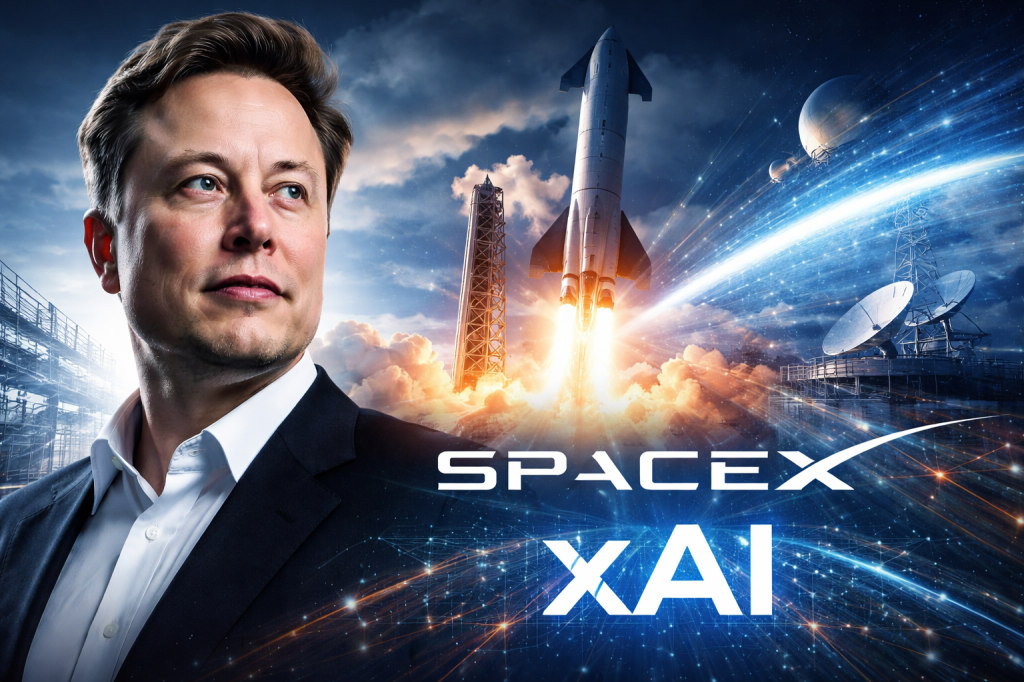
According to reporting by The Guardian, Elon Musk is moving forward with a merger between SpaceX and his artificial-intelligence startup xAI—a step that would formally bind one of the world’s most strategically important aerospace contractors to a fast-growing AI lab.
From a center-right, technology-policy perspective, the move is less about personality and more about power concentration, national interest, and regulatory blind spots.
Vertical Integration—On a National-Security Scale
Musk’s companies already span launch systems, satellite communications, electric vehicles, social media, and AI. Folding xAI into SpaceX creates a vertically integrated stack where data, compute, launch infrastructure, and government contracts intersect.
That’s not inherently wrong. In fact, conservatives often argue that private-sector scale and integration drive innovation faster than bureaucracy. SpaceX’s track record with reusable rockets and rapid iteration is proof.
But scale changes the rules. SpaceX is not just another startup—it is a core contractor for NASA and the Department of Defense. Introducing an AI subsidiary into that ecosystem raises legitimate questions about:
- How AI tools may be used in mission planning, surveillance, or autonomous systems
- Whether proprietary AI models could gain indirect access to sensitive government data
- How oversight works when innovation moves faster than regulation
Innovation vs. Accountability
Supporters argue the merger could supercharge American competitiveness. Integrating AI into aerospace could mean safer launches, better satellite coordination, and more resilient space infrastructure—especially as China accelerates its own civil-military tech fusion.
That argument deserves respect. The U.S. cannot afford to let strategic technologies stagnate.
But innovation without accountability creates risk. The federal government already struggles to regulate AI in isolation. Regulating AI embedded inside defense-critical contractors is even harder, particularly when much of the activity is shielded by national-security secrecy and private corporate structures.
The “Too Important to Fail” Problem
There is also a political reality that center-right readers should not ignore: SpaceX is now effectively indispensable. That gives Musk extraordinary leverage—over regulators, over policymakers, and over public debate.
When a single executive controls launch capability, satellite networks, a major AI platform, and a mass-audience social media site, checks and balances become fragile, even in a market-oriented system.
This isn’t an argument for heavy-handed regulation or government takeover. It is an argument for clear guardrails:
- Transparent separation between government data and private AI training
- Congressional oversight proportional to SpaceX’s national-security role
- Competition policy that encourages alternatives, not monopolies disguised as innovation
Why This Matters for Tech Policy
The SpaceX–xAI merger is a stress test for America’s approach to modern capitalism. Can the U.S. foster bold private innovation without creating unaccountable tech sovereigns? Can national security coexist with founder-driven empires?
A center-right answer should be pragmatic: back innovation, but demand responsibility. Markets work best when power is contested, not concentrated. And in emerging technologies like AI and space, the cost of getting that balance wrong isn’t just economic—it’s strategic.
Bottom line: Musk’s merger may advance American tech leadership—but only if policymakers stop pretending that 20th-century rules are sufficient for 21st-century power.


 TechBay.News
Leave a comment